Dental implants in Brussels: steps, recovery and cost
How a dental implant is placed, how long recovery takes and what it typically costs in Belgium, with reimbursement basics. A guide from a dentist in Etterbeek.
Dr Denis Cataraudentist in Etterbeek
Published 8 min read
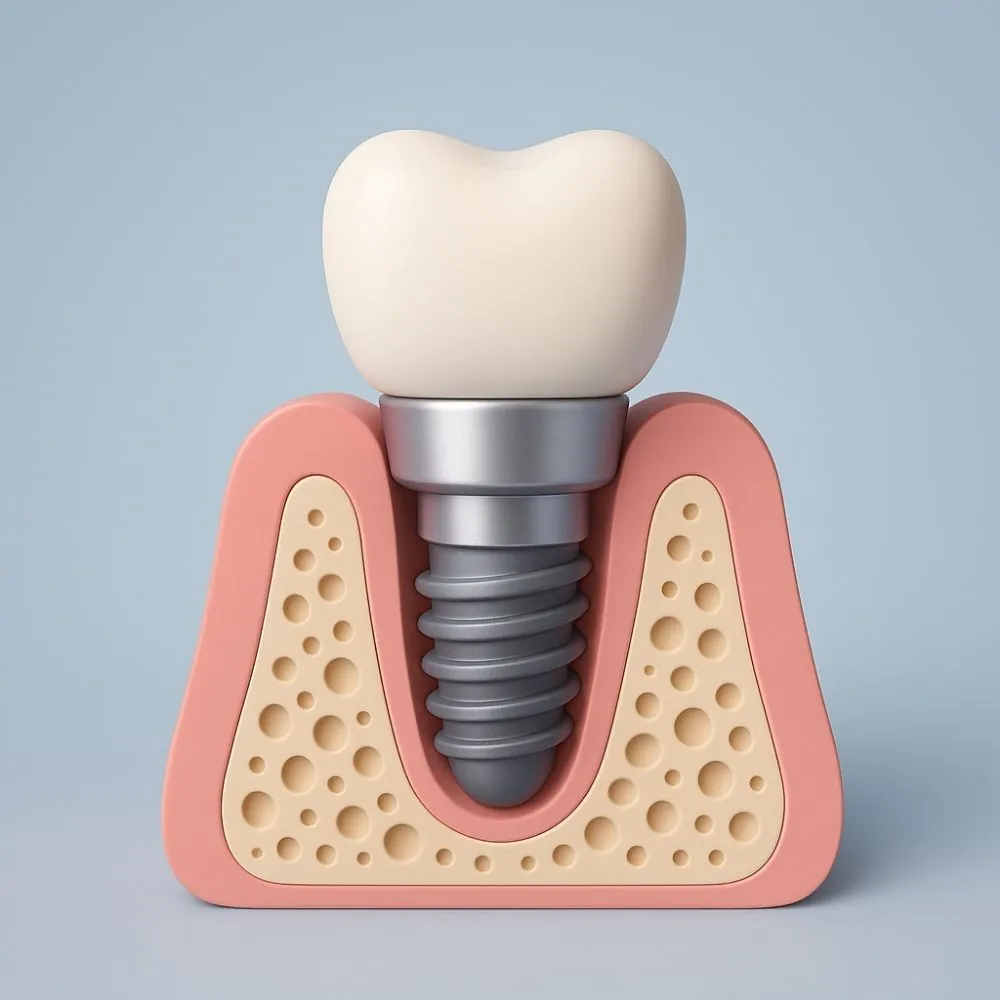
A dental implant is a small titanium (or sometimes zirconia) post placed in the jawbone to replace the root of a missing tooth; it then carries a fixed crown. The whole treatment usually takes 3 to 6 months, the time needed for the bone to bond to the implant. In Belgium, a single implant with its crown typically costs between €1,000 and €2,500, depending on the case and the materials used.
This guide answers the questions we hear most often at the practice in Etterbeek, not far from the European Quarter: how the procedure works, how long recovery takes, what an implant costs and when a bone graft is needed.
What is a dental implant and when is it recommended?
The implant replaces the root; an abutment connects it to a crown, which recreates the visible part of the tooth. Unlike a conventional bridge, it does not rely on the neighbouring teeth, so they do not need to be filed down. It also passes chewing forces to the jawbone, which helps limit the bone loss that follows the loss of a tooth.
Implants are used in several situations:
- a single missing tooth, at the front or the back of the mouth;
- several missing teeth side by side, replaced by a bridge fixed on two or more implants;
- a full arch, with a fixed prosthesis on four to six implants (All-on-4 / All-on-6);
- a loose denture, which can be stabilised on two or more implants.
More details on the indications and how treatment is organised at the practice are on our dental implants in Brussels page.
How is a dental implant placed, step by step?
- 1
Consultation and assessment
Examination of the teeth, gums and bite, X-rays and, where needed, a 3D scan (cone beam CT) to measure the bone. You then receive a treatment plan and a written quote.
- 2
Preparation, if needed
Gum treatment, removal of the failing tooth, bone grafting, or a sinus lift in the upper jaw. Many patients do not need this step.
- 3
Implant placement
Under local anaesthetic, the implant is placed in the bone. For a single implant the procedure usually takes less than an hour. A few stitches close the gum.
- 4
Osseointegration (3 to 6 months)
The bone gradually bonds to the implant surface. A temporary solution can be arranged so you are not left with a gap, especially at the front of the mouth.
- 5
Abutment and final crown
An impression is taken and a dental laboratory makes the crown, which is then screwed or cemented onto the abutment. The tooth is fully functional.
Does implant surgery hurt?
During the procedure, local anaesthetic blocks the pain: you mostly feel pressure and vibration. Afterwards, swelling, some bruising and tender gums are common. They usually peak on the second or third day and then settle. The painkillers you are advised to take, a cold compress on the cheek for the first few hours and soft, lukewarm food are generally enough. After a single implant, many patients are back to their usual routine the next day or the day after.
How long is the recovery after an implant?
The gum closes within 7 to 14 days, when the stitches are removed or dissolve. The bone needs 3 to 6 months to bond with the implant: this is osseointegration. It is often quicker in the lower jaw, where the bone is denser, and longer in the upper jaw or after a graft.
During the first few days, a few simple rules support good healing:
- chew on the other side and choose soft food that is neither too hot nor too hard;
- avoid smoking, ideally throughout the healing period;
- brush your other teeth as usual and the treated area very gently, using a mouthwash only if it has been prescribed;
- avoid strenuous exercise for two to three days.
How much does a dental implant cost in Belgium?
In Belgium, a complete single implant, meaning the implant, the abutment and the crown, usually costs between €1,000 and €2,500. The price depends on the amount of bone available, whether an extraction or a graft is needed, the position of the tooth and the crown material. For a full fixed arch on implants, the budget is generally above €10,000 per arch.
Belgian statutory health insurance generally does not reimburse implants, apart from specific situations; some top-up policies pay part of the cost. If you are covered by the EU institutions’ scheme (JSIS) or an international policy, the rules are different, so check with your insurer and ask for a written quote first. At the practice, fees are given as a quote after a consultation.
Do you need a bone graft before an implant?
Not always. A bone graft is needed when the bone is too thin or too low to hold the implant securely, which often happens when a tooth has been missing for a long time. At the back of the upper jaw, a sinus lift creates extra bone height beneath the sinus. These procedures add a step and lengthen treatment by several months. X-rays, and if needed a 3D scan, show whether a graft is required before treatment starts. See our bone graft and sinus lift page.
How long do dental implants last?
A well-integrated implant can last for many years, often several decades, as long as it is cared for like a natural tooth. The crown wears over time and may need replacing one day, without touching the implant. The main threats are inflammation of the tissues around the implant (peri-implantitis), smoking, poorly controlled diabetes and tooth grinding. Careful brushing, interdental brushes and a check-up at least once a year make a real difference.
What if several teeth, or all of them, are missing?
When several neighbouring teeth are missing, you do not need one implant per tooth: a bridge on two or three implants is often enough. For a full arch, a fixed prosthesis can be screwed onto four to six implants. These options are described on our All-on-4 and All-on-6 and full-mouth restorations on implants pages. If a crown is the only thing you need, see dental crowns.
Seeing a dentist for implants in Etterbeek
Dr Denis Catarau, a dentist with a focus on implant and cosmetic dentistry, sees patients at the dental practice at Rue des Champs 64, 1040 Etterbeek, near La Chasse, Monday to Friday from 9:00 to 18:00. Consultations are held in French, Romanian or Russian. The first appointment is used to examine your situation, discuss the realistic options (implant, bridge or removable denture) and give you a written quote you can send to your insurer before deciding. A French version of this guide is available: implant dentaire à Bruxelles.
Considering a dental implant?
Book a consultation at the Etterbeek practice to review your options.
Dr Denis Catarau
Dentist in Etterbeek (Brussels)
A dentist with a focus on implant and cosmetic dentistry and more than 10 years of experience. Trained in implantology and prosthodontics, he sees patients in French, Romanian and Russian at Rue des Champs 64, Etterbeek.
Published
More about Dr CatarauDental implants: frequently asked questions
Does having a dental implant hurt?
The procedure is done under local anaesthetic, so during placement you mainly feel pressure and vibration rather than pain. Afterwards, swelling and tenderness are common and usually peak on the second or third day. They are generally well controlled with the painkillers you are advised to take and a cold compress, and ease noticeably within a week.
How long after the implant is the crown fitted?
Usually 3 to 6 months later, once the bone has bonded to the implant (osseointegration). In the lower jaw 2 to 4 months is often enough; in the upper jaw or after a bone graft it can take 6 months or more. In carefully selected cases, a temporary crown can be fitted on the same day or within a few days.
Can an implant be placed straight after an extraction?
Sometimes. An immediate implant is possible if the extracted tooth was not infected and there is enough bone and gum to hold the implant firmly. Otherwise the area is left to heal first, usually for around two to three months, sometimes with bone grafting material placed at the time of the extraction. The decision is made after a clinical and X-ray examination.
Are dental implants reimbursed in Belgium?
As a rule, no: the statutory insurance managed through your mutuelle (health fund) only covers implants in specific situations. Some related procedures, such as the consultation, certain X-rays or an extraction, may be reimbursed under the official fee schedule. A top-up policy from your health fund or a private dental insurance may cover part of the treatment, usually with annual limits and sometimes a waiting period.
Is everyone suitable for a dental implant?
Most healthy adults can have an implant once the jaw has finished growing. Some situations call for extra care or a delay: poorly controlled diabetes, heavy smoking, untreated gum disease, radiotherapy to the head and neck, or certain medicines that affect the bone. The dentist reviews these points with you before proposing a treatment plan.
How long does a dental implant last?
A well-integrated, well-maintained implant can last for many years, often several decades. The crown wears like a natural tooth and may need replacing at some point, without changing the implant. Longevity depends mostly on daily cleaning, regular check-ups, not smoking and managing tooth grinding if you have it.
A question about your own situation?
Every mouth is different: an examination lets us give you a clear treatment plan and a written quote.