Full-mouth restoration on implants in Etterbeek, Brussels
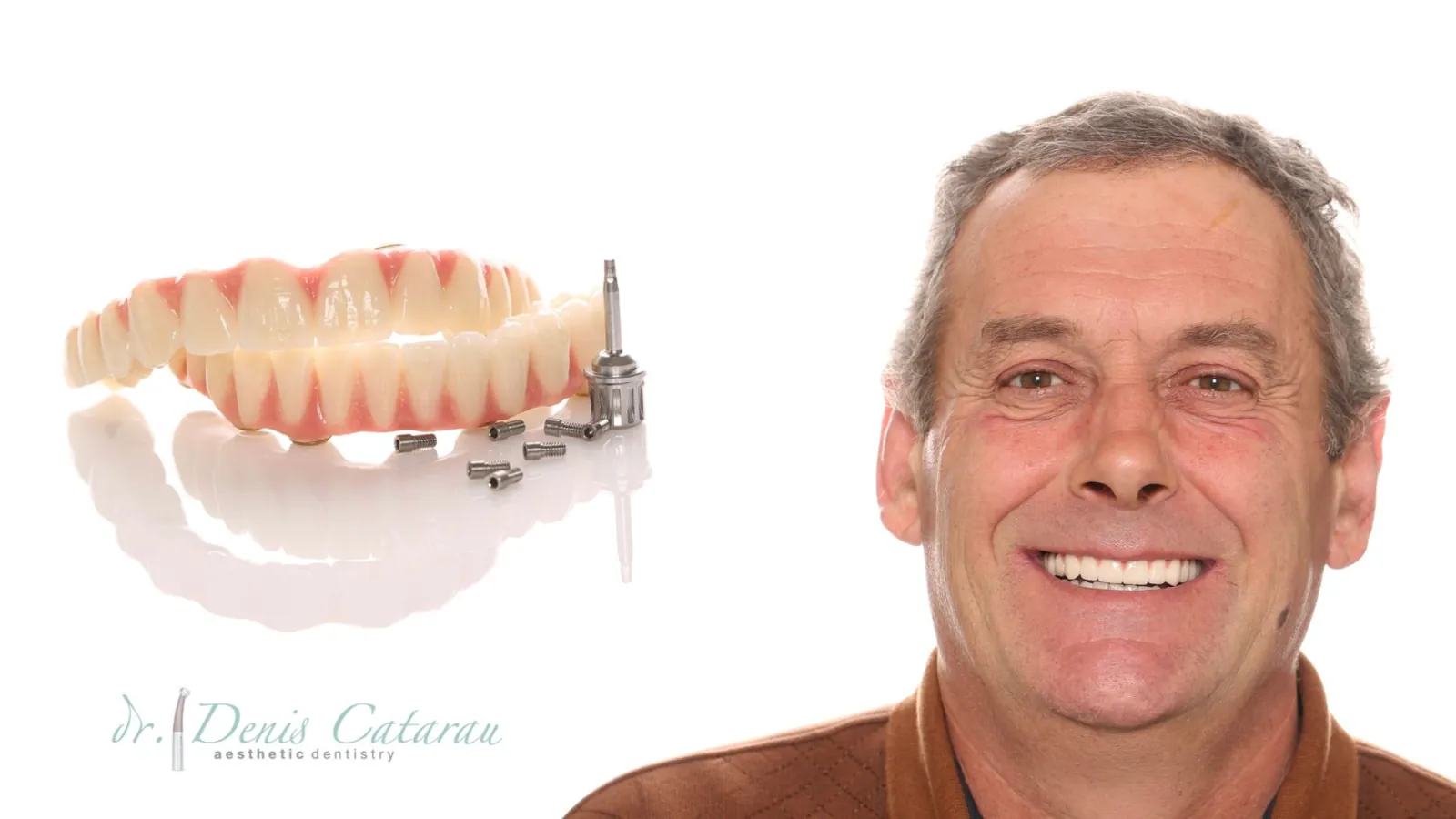
A full-mouth restoration on implants replaces all the teeth in one jaw, or both, with fixed teeth supported by implants. It is for people who have no teeth left, whose remaining teeth can no longer be saved, or who can no longer cope with their dentures. Dr Denis Catarau plans and carries out these treatments at the Cabinet dentaire Detaille, Rue des Champs 64 in Etterbeek, Brussels.
Written and reviewed by Dr Denis Catarau, dentist in EtterbeekUpdated: October 2026
- Implants per jaw
- 4 to 6, or more
- From assessment to final bridge
- 4 to 8 months
- Swelling after surgery
- 3 to 7 days
- Anaesthesia
- Local
Benefits
- Fixed teeth that do not come out, so you can chew with confidence
- No plate covering the palate in the upper jaw, so taste and texture are better preserved
- Better support for the lips and cheeks
- Implants help slow down jawbone loss
- A long-lasting solution with good care and regular check-ups
Treatment process
- 1
Full assessment: examination, X-ray and 3D imaging of the bone
- 2
Treatment plan, preview and written quote
- 3
Any extractions and, if bone is lacking, a bone graft
- 4
Placement of 4 to 6 implants (or more) per jaw under local anaesthetic
- 5
Fixed temporary teeth, sometimes within days
- 6
Final bridge after 3 to 6 months of osseointegration
Are you a candidate?
You are probably a candidate if you have lost most of your teeth, if your remaining teeth are very loose or damaged, or if your denture moves and bothers you. Your general health needs to allow minor surgery and, ideally, you should not smoke or should cut down a lot. Only an assessment with an X-ray can confirm that treatment is possible.
Options for a full arch
There are several ways to replace all the teeth in one jaw on implants. A fixed bridge on 4 to 6 implants, such as All-on-4 or All-on-6, is screwed onto the implants and can only be removed by the dentist. When there is plenty of bone, a bridge on 6 to 8 implants, sometimes in several sections, comes even closer to natural teeth. Finally, a removable denture that clips onto 2 to 4 implants is a simpler, less expensive alternative.
The choice depends on the bone volume, the condition of the gums, your smile line, your health and your budget. The two jaws are often treated differently, for example a fixed bridge at the top and an implant-retained denture at the bottom. The basics of implant treatment are explained on the dental implants page.
When there is not enough bone
After years without teeth or with a denture, the jawbone becomes thinner. All-on-4 techniques use angled implants to avoid a bone graft in many cases. When that is not enough, a bone graft or sinus lift rebuilds the bone, usually with 4 to 9 months of healing before the implants are placed or loaded.
How long does treatment take?
For a full arch, allow most often 4 to 8 months from the first assessment to the final bridge. The implants are placed in a single surgery per jaw. When the bone is solid enough, fixed temporary teeth can be fitted within days, so you are not left without teeth. The final teeth are made after osseointegration, usually 3 to 6 months later. A bone graft lengthens these timings.
After surgery: recovery
Placing several implants is done under local anaesthetic. Swelling and discomfort are normal for 3 to 7 days and ease with the prescribed medicines and ice. For the first few weeks, food should stay soft, and you should not bite into hard food with the temporary teeth. Most people return to light activity after a few days.
Aftercare and lifespan
An implant bridge needs cleaning every day, especially underneath and around the implants, with a suitable brush, interdental brushes or a water flosser. Check-ups with professional cleaning about every 6 months are recommended; the bridge can be unscrewed at the practice if needed. With good follow-up, implants and bridge last many years; the resin teeth of a bridge can wear and be renewed.
Risks and contraindications
Like any surgery, implant placement carries risks: infection, swelling, an implant that does not integrate and has to be replaced, or, more rarely, injury to a nerve or the sinus. In the long term, peri-implantitis (inflammation around the implants) is the main risk, made more likely by smoking, poorly controlled diabetes and insufficient cleaning. Some bone medicines or radiotherapy to the head and neck require medical advice first.
Cost and reimbursement
As a guide, All-on-4 usually costs more than €10,000 per arch in Belgium. A restoration on more implants, with a bone graft or with a final ceramic bridge, may cost more; an implant-retained removable denture generally costs less.
- All-on-4 (per arch, typical)
- > €10,000
- At the Etterbeek practice
- Quote after consultation
Implants are generally not reimbursed by INAMI, the Belgian compulsory health insurance, except in specific situations. Some mutuelles, supplementary dental plans and international health policies reimburse part of the cost, with ceilings. Dr Catarau is a non-contracted (non conventionné) dentist: you receive an attestation de soins for reimbursable items and a detailed written quote before treatment starts.
Frequently asked questions about full-mouth restoration
Another question? The practice answers by phone, Monday to Friday.
What is a full-mouth restoration on implants?
It is the replacement of all the teeth in one jaw, or both, with teeth fixed on implants. Depending on the available bone, 4 to 6 or more implants per jaw carry a full bridge, or 2 to 4 implants stabilise a removable denture. Treatment always starts with a clinical and X-ray assessment.
How many implants are needed for a whole jaw?
Most often 4 to 6 implants per jaw for a fixed bridge, as in the All-on-4 and All-on-6 techniques. When there is plenty of bone, 6 to 8 implants sometimes allow a bridge in several sections. For a stabilised removable denture, 2 to 4 implants are usually enough. The exact number depends on the bone, the jaw and the type of prosthesis.
Will I have teeth during treatment?
Yes, in the vast majority of cases. When the bone is solid enough, a fixed temporary bridge can be screwed onto the implants within days of surgery. Otherwise, you wear a temporary removable denture while healing. In principle, you are never left without teeth; the final teeth are fitted 3 to 6 months later.
How long does a full-mouth restoration take?
Usually 4 to 8 months from the first assessment to the final teeth. The implants are placed in one surgery per jaw, then the bone needs 3 to 6 months to bond to them. If a bone graft or sinus lift is needed, add a further 4 to 9 months of healing in most cases.
How much does a full-mouth restoration on implants cost?
In Belgium, a fixed All-on-4 bridge usually costs more than €10,000 per arch, as a guide. The price depends on the number of implants, any bone graft, the temporary teeth and the material of the final bridge. At the Etterbeek practice, you receive a detailed written quote after the assessment, before you decide anything.
Can I have implants after wearing dentures for many years?
Often, yes. After years of wearing dentures, the bone is usually thinner, but All-on-4 techniques with angled implants make it possible to avoid a bone graft in many cases. If the bone really is insufficient, a bone graft can rebuild it first. 3D imaging of the bone shows which option is possible.
Is having so many implants placed painful?
The surgery is done under local anaesthetic and does not hurt during the procedure. Afterwards, swelling and discomfort are normal for 3 to 7 days, and are usually well controlled with the prescribed medicines and ice. Plan a few quiet days after surgery and a soft diet for the first weeks while the implants settle.
How long does an implant bridge last?
With good care and regular check-ups, the implants and bridge last many years; the implants themselves often stay in place for more than 10 to 15 years. The resin teeth of a bridge can wear and be renewed without removing the implants. Smoking, poorly controlled diabetes and insufficient cleaning shorten this lifespan.
Read more
The treatments that make up a full-mouth restoration, each explained in detail on its own page.
- All-on-4 and All-on-6: a fixed full arch on 4 to 6 implantsWho it suits, stages, temporary teeth, timeline and typical costs in Belgium.
- Bone graft and sinus liftRebuilding missing bone before implants: techniques and healing.
- Dental implants in EtterbeekHow an implant works, osseointegration, aftercare and risks.
Book a consultation in Etterbeek
At the first assessment at the Cabinet dentaire Detaille, Rue des Champs 64 in Etterbeek, Dr Denis Catarau examines your mouth, assesses the bone and explains the possible options, with a detailed written quote.