Dental crowns in Etterbeek, Brussels: ceramic, zirconia or on an implant
A dental crown is a custom-made cap that fully covers a damaged tooth, or sits on an implant, to restore its shape, strength and appearance. It is usually completed in 2 appointments. Dr Denis Catarau provides ceramic and zirconia crowns at the Detaille dental practice in Etterbeek, Brussels.
Written and reviewed by Dr Denis Catarau, dentist in EtterbeekUpdated: October 2026
- Appointments
- Usually 2
- Time between visits
- Usually 1-2 weeks (made in a dental laboratory)
- Anaesthesia
- Local, if needed
- Lifespan
- Often 10-15 years or more with good care
- Materials
- Ceramic, zirconia; porcelain-fused-to-metal where appropriate
What is a dental crown?
A crown replaces the whole visible part of a tooth, down to the gum line. Unlike a filling or an inlay, which only fill part of the tooth, a crown surrounds it completely and protects it from fracturing. Unlike a veneer, which only covers the front surface, it both strengthens and improves the look of the tooth.
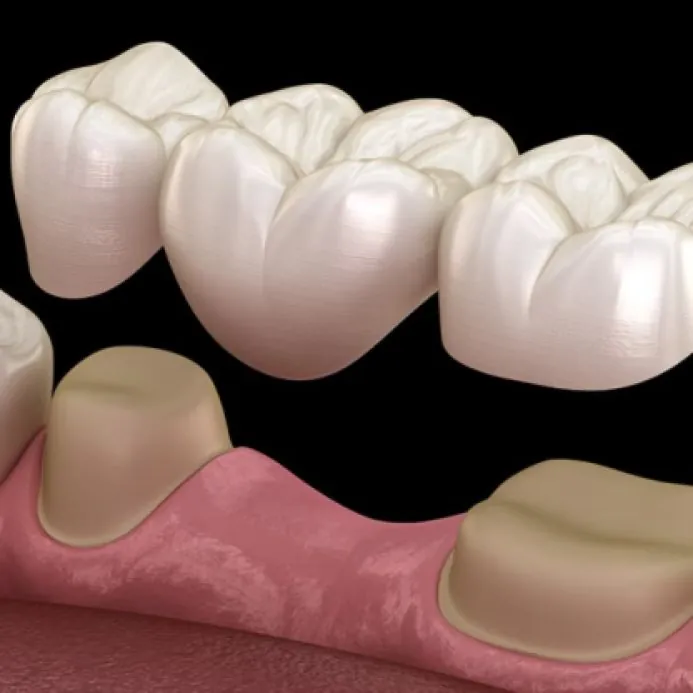
Several crowns joined together form a bridge, which replaces a missing tooth by resting on the neighbouring teeth. A crown can also be fixed onto an implant to replace a lost tooth.
When do you need a crown?
A crown is recommended when a tooth can no longer be reliably repaired with a simple filling. The most common situations are:
- A tooth badly damaged by decay, or with a large filling that is cracking.
- A molar or premolar after root canal treatment: the tooth becomes more brittle and may split.
- A fractured or cracked tooth.
- Heavy wear, for example from teeth grinding (bruxism).
- An old crown that needs replacing: leakage, a visible dark edge, irritated gums.
- Replacing a missing tooth, on an implant.
Ceramic, zirconia or porcelain-fused-to-metal?
The choice depends on where the tooth is, how strong your bite is and what you expect aesthetically. Dr Catarau explains what suits your case best.
- All-ceramic (metal-free): very natural and translucent, particularly suited to front teeth.
- Zirconia: very strong and metal-free, often chosen for molars or heavy chewing; it can also be layered with ceramic for a more natural look.
- Porcelain-fused-to-metal: a metal framework covered with porcelain. A solid, long-established option, although a grey line can appear at the gum margin over time.
Crown on a natural tooth or on an implant
On a natural tooth, the tooth is first shaped evenly (usually 1 to 2 mm is removed) to make room for the crown, which is then cemented or bonded. If the tooth is badly broken down, it is rebuilt beforehand.
On an implant, no tooth is shaped: the crown is attached to an abutment connected to the implant, either screwed or cemented. It cannot decay, but the gum and bone around the implant need cleaning just as carefully as a natural tooth.
Lifespan and care
A well-made crown often lasts 10 to 15 years, sometimes much longer. The tooth underneath is still there and can decay where the crown meets the gum. Brush twice a day, clean between your teeth with floss or interdental brushes and have regular check-ups, usually once or twice a year.
If you grind your teeth, a night guard protects the crown. Avoid biting hard objects (pens, ice cubes, fruit stones): ceramic is strong but can chip.
The steps
- 1
Consultation and X-ray
An examination of the tooth and an X-ray to check the root and nerve. If needed, root canal treatment or a core build-up is done first.
- 2
Preparation and impression
Under local anaesthetic if needed, the tooth is shaped, an impression or digital scan is taken and the shade is chosen. A temporary crown protects the tooth in the meantime.
- 3
Laboratory work
A dental laboratory makes the crown to measure, usually within 1 to 2 weeks. Meanwhile, avoid very sticky food on the side of the temporary crown.
- 4
Try-in and fitting
The crown is tried in, adjusted so that your bite feels comfortable, then permanently cemented or bonded. This appointment usually takes less than an hour.
- 5
Check-up
A follow-up visit checks the gum and your bite. After that, the crown is monitored at your routine check-ups.
Dental crown cost and reimbursement
In Belgium, the price of a crown depends mainly on the material, the laboratory work and any treatment needed beforehand (root canal, build-up). The figures below are general market context, not this practice’s fees.
- Ceramic or zirconia crown in Belgium (indicative)
- Often about €500-1,200 per tooth
- Crown on an implant
- Part of the overall implant cost (often €1,000-2,500 in Belgium for implant, abutment and crown)
- Reimbursement
- Depends on the treatment, your age and your mutuelle
- At the practice
- Quote after consultation
Dr Catarau is a non-contracted (non conventionné) dentist, so his fees may be higher than the INAMI agreed rates. The practice gives you a certificate of care (attestation de soins); statutory reimbursement applies to treatments listed in the official fee schedule. Exact price on quote after consultation.
Dental crowns: frequently asked questions
Another question? The practice answers by phone, Monday to Friday.
How much does a dental crown cost in Belgium?
As a rough guide, a ceramic or zirconia crown often costs between about €500 and €1,200 in Belgium. The price depends on the material, the laboratory work and any treatment needed before fitting. At the Detaille practice in Etterbeek, you receive the exact price on a written quote after the tooth has been examined.
Is a dental crown reimbursed?
It depends on the treatment carried out, your age and your mutuelle. The practice gives you a certificate of care to submit to your mutuelle, and some top-up or dental insurance policies pay part of the rest, within limits. As Dr Catarau is non-contracted, his fees may exceed INAMI rates, so ask for a quote to check in advance.
How long does a dental crown last?
A crown often lasts 10 to 15 years, and sometimes much longer. Its lifespan depends mainly on oral hygiene, regular check-ups and habits: teeth grinding or biting hard objects can damage it. The tooth underneath can still decay at the gum line, which is why flossing matters.
Ceramic or zirconia: which should I choose?
Ceramic is often preferred for front teeth because it looks very natural and translucent. Zirconia is stronger and suits molars or people who clench their teeth. Both are metal-free and well tolerated by the gums. The choice is made with your dentist, based on the tooth and your bite.
Does getting a crown hurt?
Usually not. The tooth is prepared under local anaesthetic if it is still alive, and fitting the final crown is generally painless. Mild sensitivity to cold or chewing can appear for a few days afterwards; if it lasts more than two weeks, let your dentist know.
How many appointments does a crown take?
Usually 2 appointments: one to prepare the tooth, take an impression or scan and fit a temporary crown, then a second one 1 to 2 weeks later to fit the permanent crown. If the tooth first needs root canal treatment or a build-up, one or more extra appointments are added.
Does the tooth need a root canal before a crown?
Not always. A healthy, living tooth can receive a crown without root canal treatment. A root canal is only needed if the nerve is infected, badly inflamed or too close to the area being prepared. The X-ray and tests carried out at the consultation show whether this is the case.
What is the difference between a crown and a veneer?
A veneer is a thin shell bonded only to the front of a tooth, mainly for cosmetic reasons. A crown covers the whole tooth and strengthens it, so it suits teeth that are damaged, fractured or root-filled. A veneer usually requires removing less enamel than a crown.
Related treatments
Treatments that are often considered together.
A damaged tooth? Let’s take a look
At a consultation at the Detaille dental practice in Etterbeek, Dr Catarau examines the tooth, explains whether you need a crown or whether a simpler option will do, and gives you a quote. Book online through Doctoranytime.