Dental implants in Etterbeek, Brussels
Dentist with a focus on implant dentistry · Cabinet dentaire Detaille
A dental implant is an artificial titanium root placed in the jawbone to hold a crown, a bridge or a full arch of teeth. It replaces one or more missing teeth without touching the neighbouring teeth. Dr Denis Catarau places and restores implants at the Cabinet dentaire Detaille, Rue des Champs 64 in Etterbeek, Brussels, after a full clinical and X-ray assessment.
Written and reviewed by Dr Denis Catarau, dentist in EtterbeekUpdated: October 2026
- Appointments
- 4 to 6 for a single implant
- Treatment time
- 3 to 6 months
- Implant placement
- 30 to 60 min, under local anaesthetic
- INAMI reimbursement
- Generally not reimbursed
Why choose a dental implant?
- A fixed tooth that feels stable when you chew and speak
- No need to file down the neighbouring teeth, unlike a bridge
- Helps preserve the bone where the tooth was lost
- A natural look with a ceramic or zirconia crown
- Long-lasting: often more than 10 years with good care
- Works for one tooth, several teeth or a full arch
What is a dental implant?
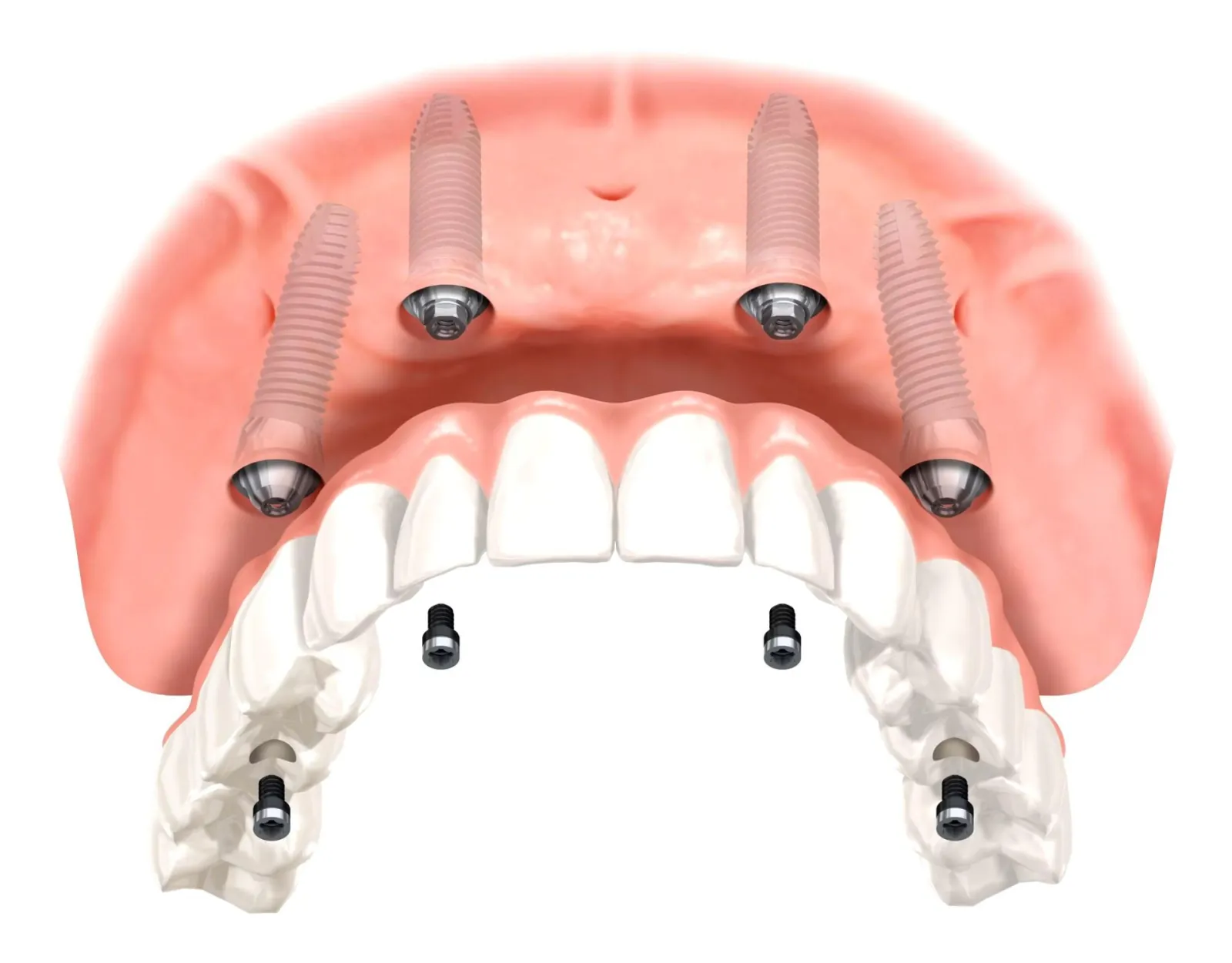
An implant has three parts: the titanium screw placed in the bone, which acts as the root; the abutment, which connects the implant to the visible tooth; and the dental crown, usually ceramic or zirconia and made to measure. Over time, the bone bonds to the surface of the implant. This process, called osseointegration, is what makes an implant as stable as a natural root.
An implant is not "screwed into the gum": it is placed in the bone, under local anaesthetic, during a minor surgical procedure. The final tooth is fitted once the implant has integrated or, in carefully selected cases, earlier.
Who are dental implants for?
Implants suit most adults who have lost one or more teeth, provided the jaws have finished growing and their general health allows it. They are worth considering in particular when you have:
- a tooth lost after an accident, a fracture or an infection;
- a tooth that cannot be saved and needs to be extracted;
- several missing teeth side by side that you would rather not replace with a removable denture;
- no teeth left in one jaw, or a denture that moves and bothers you every day;
- an old bridge to replace, with weakened supporting teeth.
Options for your situation
Before suggesting an implant, Dr Catarau checks the amount and quality of the bone and the health of your gums and other teeth. If the bone is too thin or too low, a bone graft or sinus lift may be needed first.
For a single tooth, one implant holds one crown. For several neighbouring teeth, two implants can carry a bridge of three or four teeth without filing down any natural teeth. When all the teeth in one jaw are missing or need to come out, All-on-4 or All-on-6 fixes a full arch on four to six implants.
Another option is a removable denture stabilised on two to four implants: you take it out to clean it, but it no longer moves when you eat. For more extensive cases, a full-mouth restoration on implants combines these solutions in one plan. The choice depends on the available bone, your expectations and your budget, and is always discussed at the consultation.
Implant solutions offered at the practice
- Single implant with a crown
- Implant-supported bridge (several teeth)
- All-on-4 / All-on-6: a fixed full arch
- Removable denture stabilised on implants
Dental implant treatment, step by step
For a single implant, treatment usually takes 4 to 6 appointments spread over 3 to 6 months.
- 1
Consultation and assessment
Examination, panoramic X-ray and, if needed, 3D imaging of the bone. You receive a treatment plan and a written quote.
- 2
Preparation
Treatment of any decay or gum disease, extraction if needed and, if bone is lacking, a bone graft or sinus lift.
- 3
Implant placement
Under local anaesthetic, usually 30 to 60 minutes per implant. Stitches come out after about 7 to 10 days.
- 4
Osseointegration
The bone bonds to the implant, usually over 3 to 6 months. A temporary tooth can be planned for appearance.
- 5
Final crown
Impression, try-in and fitting of the crown or bridge on the abutment, over 2 to 3 appointments.
- 6
Follow-up
A check a few weeks after fitting, then regular check-ups and professional cleaning every 6 to 12 months.
How long does treatment take?
For a single implant in sufficient bone, allow on average 3 to 6 months between placing the implant and fitting the final crown. If the tooth must be removed first, the implant can be placed the same day (an immediate implant, when the bone allows), after 6 to 8 weeks, or after 3 to 6 months when the bone needs to heal first.
A bone graft or sinus lift adds time: usually 4 to 9 months before the implant is placed or loaded. The number of visits stays small, which helps if you work full-time in Brussels or around the European Quarter.
Pain and recovery
The procedure itself does not hurt, because it is done under local anaesthetic. Afterwards, some discomfort, swelling or minor bruising is common for 2 to 4 days; it usually settles with standard painkillers and a cold compress. The gum heals on the surface in 7 to 14 days. Most people are back at work the next day or the day after.
- First 24 hours: soft, lukewarm food, no vigorous rinsing and no strenuous exercise.
- Avoid smoking: it slows healing and increases the risk of the implant failing.
- Brush your other teeth as usual and clean the area gently, as instructed.
- Call the practice if the pain increases after day three, if you have a fever or if bleeding does not stop.
Lifespan and aftercare
A well-integrated, well-maintained implant can last many years, often more than 10 to 15, and sometimes a lifetime. The crown on top can wear or chip, and can then be replaced without removing the implant.
Aftercare is much like caring for natural teeth: brushing twice a day, interdental brushes or floss, and regular check-ups with professional cleaning. The main long-term threat is peri-implantitis, an inflammation of the gum and bone around the implant, made more likely by plaque, smoking and poorly controlled diabetes.
Risks and contraindications, in plain words
Implant placement is a routine procedure, but like any surgery it carries risks: infection, bleeding, swelling, an implant that does not bond to the bone (it is then removed and can be replaced after healing) and, more rarely, injury to a nerve or the sinus. A careful X-ray assessment greatly reduces these risks.
Some situations call for extra care or a delay: heavy smoking, poorly controlled diabetes, untreated gum disease, certain bone medicines (bisphosphonates, for example) or radiotherapy to the head and neck. Tell us about your medical history and bring a list of your medicines to the consultation.
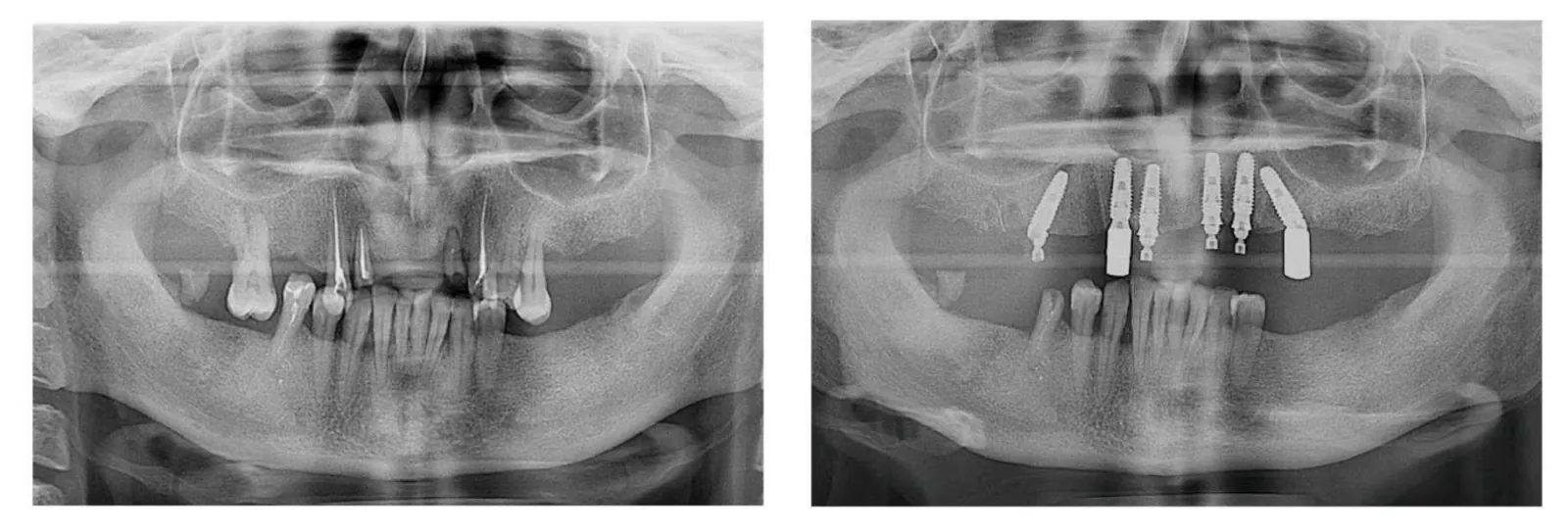
Clinical case: full lower-jaw rehabilitation with 6 implants and a fixed bar-supported restoration
The patient presented with full edentulism in the lower jaw and non-restorable teeth in the upper arch, which severely affected chewing ability and facial esthetics.
The treatment plan included extraction of the compromised teeth and the placement of six dental implants in the mandible. A fixed bar-supported prosthetic restoration was mounted on the implants, providing excellent stability, natural esthetics, and full oral functionality. The outcome was a clear smile transformation and a significant improvement in the patient's quality of life.
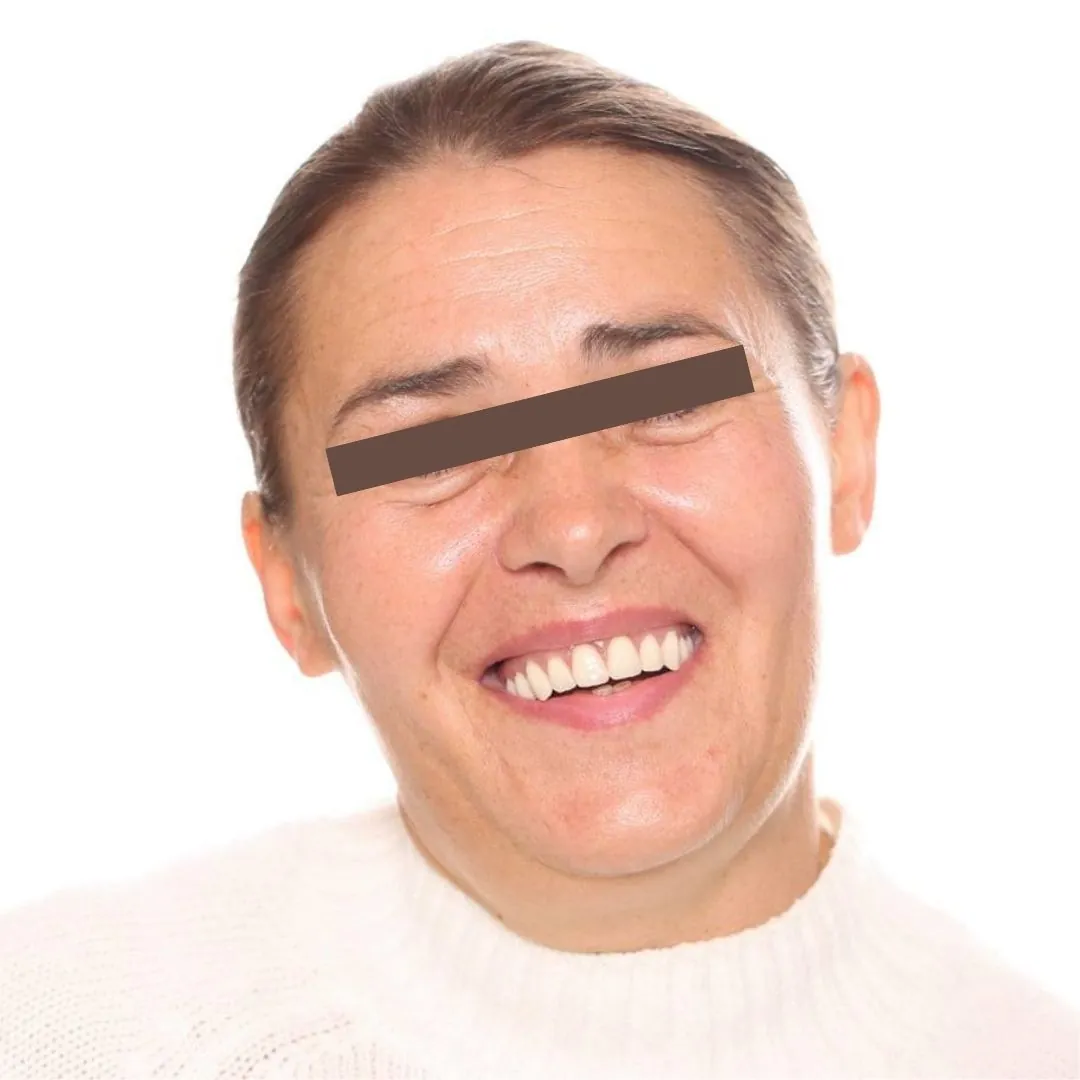
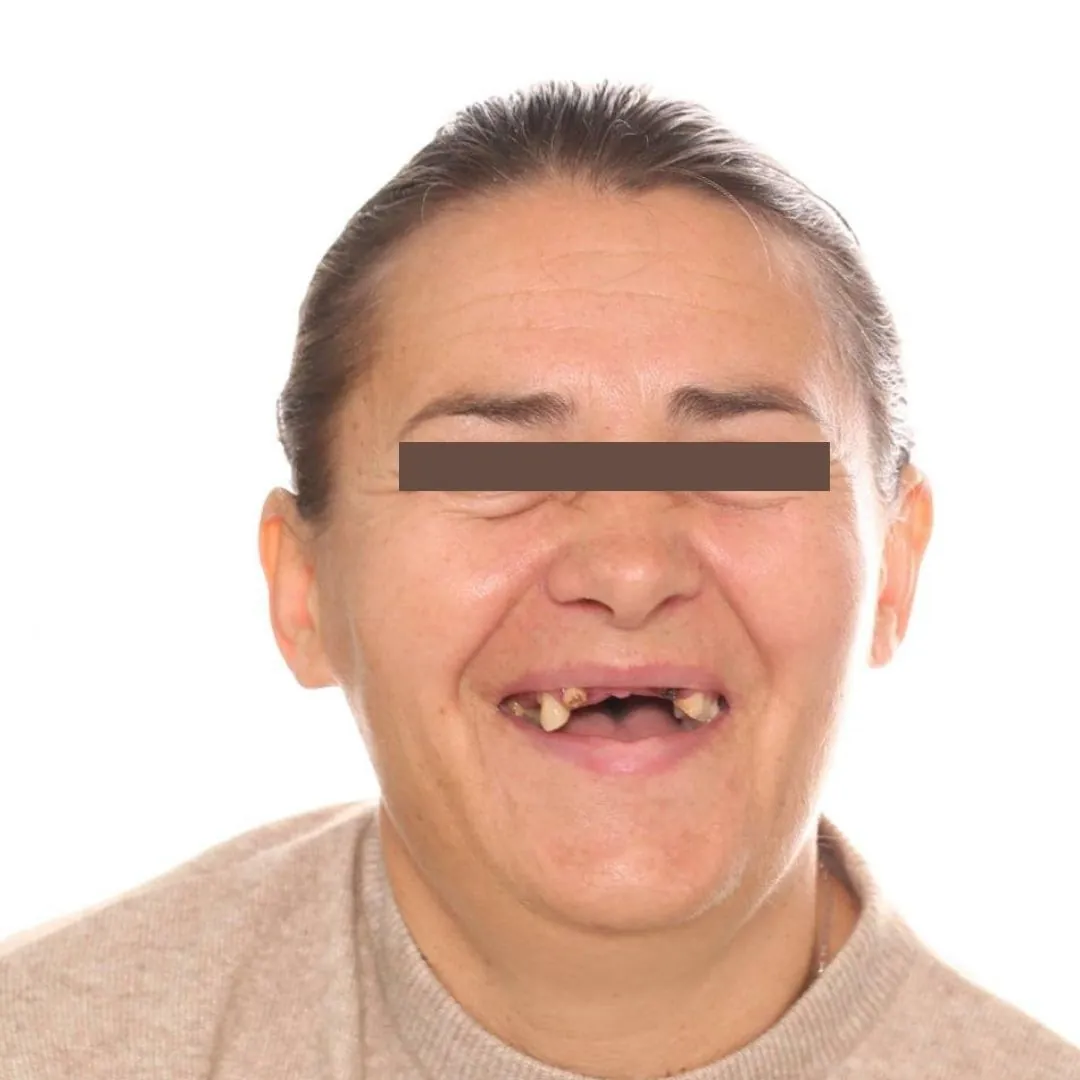 BeforeAfter
Dental implant cost and reimbursement
As a guide, a complete single implant (implant, abutment and crown) usually costs between €1,000 and €2,500 in Belgium, depending on the case and the materials. A bone graft, a temporary tooth or 3D imaging are added if needed. A full arch such as All-on-4 usually costs more than €10,000 per arch.
- Complete single implant (Belgium, typical)
- ≈ €1,000-2,500
- All-on-4 (per arch, typical)
- > €10,000
- At the Etterbeek practice
- Quote after consultation
Belgian compulsory health insurance (INAMI/RIZIV) generally does not cover implants, except in specific situations. Some mutuelles and supplementary dental plans reimburse part of the cost, with ceilings and waiting periods; international and expat health plans vary, so check your policy using our written quote. Dr Catarau is a non-contracted (non conventionné) dentist: his fees may be higher than the INAMI agreement rates, but you receive an attestation de soins for reimbursable treatment.
Frequently asked questions about dental implants
Another question? The practice answers by phone, Monday to Friday.
How much does a dental implant cost in Brussels?
In Belgium, a complete single implant (implant, abutment and crown) usually costs between €1,000 and €2,500, depending on the situation and the materials. A bone graft or temporary tooth is added if needed. At the Etterbeek practice, the exact price is set out in a written quote after the consultation and X-ray, before you commit to anything.
Are dental implants covered by insurance in Belgium?
Belgian compulsory insurance (INAMI) generally does not reimburse implants, except in specific situations defined by the regulations. Some mutuelles, supplementary dental plans and international health policies cover part of the cost, usually with annual ceilings and sometimes a waiting period. Ask your insurer using the practice's written quote. The consultation and X-rays are reimbursed under the usual rules.
Does getting a dental implant hurt?
No, the placement itself does not hurt, because it is done under local anaesthetic: you only feel pressure. Afterwards, discomfort and swelling are common for 2 to 4 days, similar to a tooth extraction. They usually settle with standard painkillers and a cold compress, and most people return to work the next day.
How long after the implant is the crown fitted?
Usually 3 to 6 months later, once osseointegration, the bonding of the bone to the implant, is complete. It is often shorter in the lower jaw, where the bone is denser, and longer after a bone graft or sinus lift (4 to 9 months). In favourable cases, a temporary crown can be fitted earlier, sometimes on the same day.
How long should I wait after an extraction before having an implant?
There are three options: an immediate implant, placed on the day the tooth is removed if the bone and gum allow; an early implant, placed after 6 to 8 weeks of gum healing; and a delayed implant, placed after 3 to 6 months when the bone first needs to rebuild. The choice is made after a clinical examination and an X-ray.
How long does a dental implant last?
A well-integrated, well-maintained implant often lasts more than 10 to 15 years and can stay in place for life. Its lifespan depends mainly on oral hygiene, smoking, diabetes control and regular check-ups. The crown may wear or chip over time; it can then be replaced without removing the implant.
Do I need a bone graft before an implant?
Not always. A bone graft is only needed when the bone is too thin or too low to hold the implant securely, which shows up on an X-ray or 3D scan. It is common when a tooth was lost long ago, or at the back of the upper jaw beneath the sinus. A small graft can often be done during the same appointment as the implant.
Implant or bridge: which is better?
For one missing tooth between healthy teeth, an implant is often the better choice, because the neighbouring teeth do not need to be filed down and the bone is better preserved. A bridge remains a good option when the neighbouring teeth already have large fillings or crowns, or when an implant is not possible. The choice depends on your mouth, your health and your budget.
Can I get fixed teeth on the same day?
Sometimes. When the bone is solid enough, a temporary tooth or bridge can be fixed on the implants on the day of surgery or within a few days. This is not possible for everyone, and temporary teeth must be treated gently while the bone heals. The final teeth are made after osseointegration, usually 3 to 6 months later.
Is there an age limit for dental implants?
There is no upper age limit: what matters is your general health, the quality of your bone and your ability to keep the implant clean. Implants are, however, not placed until the jaws have finished growing, usually around the age of 18 to 20. In older patients, implants are often used to stabilise a loose denture.
Read more
Treatments related to dental implants, each explained in detail on its own page.
- All-on-4 and All-on-6: a fixed full arch on 4 to 6 implantsReplacing every tooth in one jaw with a fixed bridge, often with temporary teeth shortly after surgery.
- Bone graft and sinus lift before an implantWhen the bone is too thin or too low: techniques, healing and waiting time before the implant.
- Full-mouth restoration on implantsOne overall plan to get fixed teeth again after losing many teeth.
- Implant crowns: ceramic or zirconiaChoosing the material, the number of visits and how long the crown lasts.
- Before-and-after clinical casesImplant restorations carried out by Dr Catarau, in photos.
- About Dr Denis CatarauHis training in implant and prosthetic dentistry, his career and the languages he speaks.
Book a consultation in Etterbeek
At the first consultation we examine your mouth, take any X-rays needed and explain your options, with a written quote. The Cabinet dentaire Detaille is at Rue des Champs 64, Etterbeek (near La Chasse), open Monday to Friday, 9 am to 6 pm.