Dental veneers in Brussels: porcelain or composite
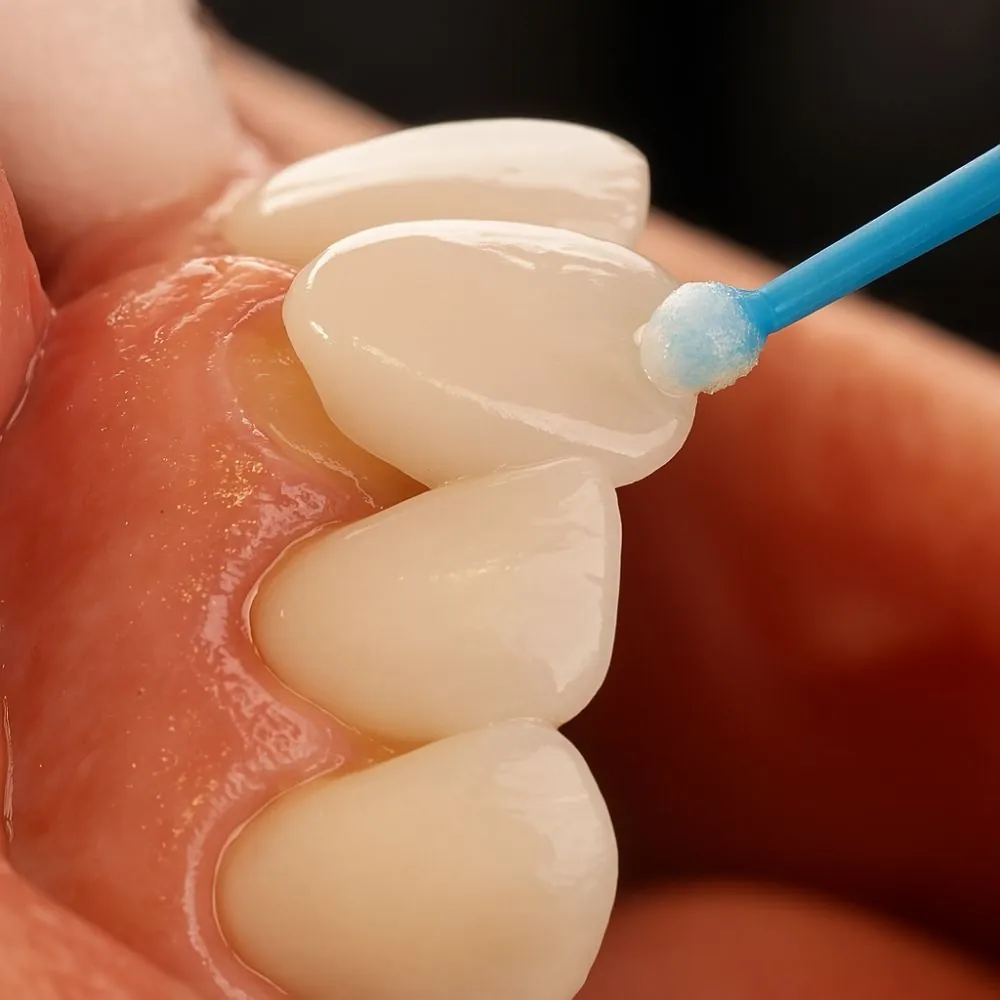
Dental veneers are thin layers of porcelain or composite bonded to the visible front of the teeth to change their colour, shape or length. At the practice in Etterbeek, Dr Denis Catarau places porcelain veneers over 2 to 3 visits and composite veneers usually in a single visit, removing as little enamel as possible.
Written and reviewed by Dr Denis Catarau, dentist in EtterbeekUpdated: October 2026
- Visits
- 2-3 (porcelain) · 1-2 (composite)
- Preparation
- 0.3-0.7 mm of enamel, sometimes none
- Lifespan
- 10-15 years (porcelain) · 5-7 years (composite)
- INAMI cover
- None (cosmetic treatment)
What is a dental veneer?
A veneer is a very thin shell, roughly as thick as a fingernail, permanently bonded to the front surface of a tooth. It does not replace the tooth; it changes how the tooth looks, a bit like a new surface. Veneers are mainly used on the incisors and canines, sometimes on the premolars too: the teeth that show when you smile.
A veneer is not a crown. A crown covers the whole tooth and means trimming it on every side; a veneer only covers the visible face and, in most cases, only the enamel.
- Discoloured teeth that respond poorly to whitening (tetracycline staining, fluorosis, a darkened root-filled tooth)
- Chipped, worn or fractured edges
- Small gaps between the teeth (diastema)
- Teeth that are short, irregular in shape or asymmetrical
- Mild misalignment, when orthodontic treatment is not wanted
Porcelain or composite veneers: what is the difference?
A porcelain veneer is custom-made in a dental laboratory and bonded at a later appointment. Porcelain reproduces the translucency of enamel very well, does not stain with coffee, tea or red wine, and lasts a long time. In return, it usually needs light preparation of the tooth and several visits.
A composite veneer is sculpted directly in the mouth, layer by layer, with a tooth-coloured resin. You see the result after one visit, the tooth needs little or no preparation and touch-ups are easy. Composite is less hard-wearing, though: it can stain or chip over time and needs regular polishing.
- Porcelain: the most natural look, stable colour, 10-15 years and often longer, higher cost
- Composite: usually one visit, minimally invasive, repairable, around 5-7 years on average with maintenance
Minimal preparation: what happens to the tooth underneath?
So that a porcelain veneer does not look bulky, between 0.3 and 0.7 mm of enamel is usually removed from the front of the tooth. This is guided by a smile design agreed with you beforehand, so that only what is needed is taken away. When a tooth is small or set back, a veneer can sometimes be bonded with little or no preparation.
It is worth knowing before you start: enamel that is removed does not grow back. A tooth prepared for a porcelain veneer will always need to be covered by a veneer or another restoration. This is why Dr Catarau favours guided preparations kept within the enamel, which is also where bonding is strongest.
Who are veneers for, and when is it better to wait?
Veneers suit adults whose teeth and gums are healthy. A few things are checked before they are suggested.
- Decay or gum disease: these are treated first
- Bruxism (clenching or grinding): veneers are possible, with a protective night guard
- Severely crowded or crooked teeth: orthodontics may be more suitable and less invasive
- A heavily broken-down tooth or very little enamel: a crown can be more reliable than a veneer
- Under 18, it is usually best to wait until the teeth and gums have finished developing
How long veneers last and how to look after them
A well-bonded porcelain veneer typically lasts 10 to 15 years, and often longer. A composite veneer lasts around 5 to 7 years on average, with touch-ups and polishing along the way. How long they really last depends mostly on oral hygiene, habits such as nail or pen biting and grinding, and regular check-ups.
Care is straightforward: brush twice a day, clean between the teeth daily with floss or interdental brushes, and have a check-up and scale and polish once or twice a year. The tooth under the veneer is still alive and can decay at the edges, so check-ups help catch problems early.
How veneer treatment works
- 1
Consultation and assessment
An examination of your teeth and gums, photos, X-rays if needed, and a conversation about what you would like to change. You leave with a treatment plan and a written quote.
- 2
Smile design and trial
The shape of your new teeth is designed on a model or digitally, then tried in your mouth with a temporary resin. You see the result before any enamel is touched.
- 3
Preparation and impression
Light enamel preparation, under local anaesthetic if needed, a digital or conventional impression and temporary veneers. The laboratory makes the veneers in one to two weeks. Composite veneers are sculpted directly at this visit.
- 4
Bonding and review
The veneers are tried in, the shade is confirmed, then they are permanently bonded and your bite is adjusted. A review follows a few weeks later, then at your routine check-ups.
How much do veneers cost in Belgium?
The cost depends on the material, the number of teeth and how complex the case is. As a rough guide, these are the ranges generally seen in Belgium.
- Porcelain veneer (per tooth)
- around €800-€1,500
- Composite veneer (per tooth)
- around €250-€500
- INAMI reimbursement
- none (cosmetic treatment)
- Mutuelle or dental insurance
- sometimes partial, depending on the policy
These figures are a guide to the Belgian market, not the practice’s fees. Dr Catarau is a non-contracted (non-conventionné) dentist: the cost of your treatment is set out in a quote after consultation.
Frequently asked questions about veneers
Another question? The practice answers by phone, Monday to Friday.
Do veneers damage your teeth?
Porcelain veneers usually require removing 0.3 to 0.7 mm of enamel, which is irreversible: the tooth will always need to stay covered. Composite veneers and some very thin porcelain veneers need little or no preparation. A well-bonded, well-maintained veneer does not harm the tooth; the main risk is decay at the edges if oral hygiene slips.
Veneers or composite bonding: which should I choose?
Composite bonding suits small corrections such as a chipped corner, a small gap or a slightly short tooth, done in one visit without drilling. Veneers, especially porcelain, are better for a lasting change to the colour and shape of several teeth. Bonding costs less and is easy to repair; porcelain lasts longer and does not stain.
How much do veneers cost in Belgium?
In Belgium, a porcelain veneer generally costs between €800 and €1,500 per tooth, and a composite veneer between €250 and €500 per tooth. INAMI does not reimburse veneers because they are cosmetic; some mutuelles or private dental insurers cover part of the cost. At the practice in Etterbeek, the exact price is given in a quote after consultation.
How long do dental veneers last?
A porcelain veneer usually lasts 10 to 15 years, often longer with good hygiene and regular check-ups. A composite veneer lasts around 5 to 7 years on average and needs polishing from time to time. Grinding, nail biting or biting hard objects shortens that lifespan; a night guard protects veneers if you grind your teeth.
Does getting veneers hurt?
Getting veneers is generally only mildly uncomfortable. Enamel preparation is done under local anaesthetic if needed, and composite veneers often need none at all. Some mild sensitivity to cold can appear for a few days after preparation or bonding, and in the vast majority of cases it settles on its own.
How many appointments do veneers take?
Porcelain veneers take 2 to 3 appointments over about two to three weeks: consultation and design, preparation with an impression, then bonding. Composite veneers are usually completed in a single session lasting a few hours, sometimes two sessions when several teeth are treated.
Can veneers be whitened?
No, veneers cannot be whitened: neither porcelain nor composite responds to whitening products. If you want lighter teeth, whitening is done before the veneers, and the veneer shade is then matched to the new result. A composite veneer that has dulled can, however, be re-polished or redone.
Related treatments
Treatments that are often considered together.
Thinking about veneers? Let’s talk in Etterbeek
Dr Denis Catarau examines your teeth, explains the options (porcelain, composite or another approach) and gives you a clear written quote. The practice is on Rue des Champs, near La Chasse, close to the European Quarter.