Smile design
Photos, a smile analysis and, if useful, a try-in mock-up so you can see the result before anything irreversible is done.
Veneers, composite bonding, teeth whitening and gum contouring
Cosmetic dentistry improves the colour, shape and apparent alignment of your teeth while keeping them healthy. Veneers, composite bonding, whitening or gum contouring: the treatment is chosen after an assessment and a conversation about what you would like. Dr Denis Catarau, a dentist focused on cosmetic and implant dentistry, sees patients at the Cabinet dentaire Detaille, Rue des Champs 64 in Etterbeek, Brussels.
Written and reviewed by Dr Denis Catarau, dentist in EtterbeekUpdated: October 2026
Cosmetic dentistry covers treatments aimed at how your smile looks: the shade of your teeth, their shape and length, small gaps, chipped corners or an uneven gum line. It does not replace basic care: healthy teeth and gums always come first, and cosmetic work is only done once the mouth is healthy.
The goal is not one "perfect" smile for everyone, but a result that looks like you, in harmony with your face, lips and age. That is why the least invasive options, which keep as much enamel as possible, are preferred.
The right treatment depends on what bothers you, the condition of your enamel and how long you want the result to last. These are the most common options; the final choice is always made after an examination.
Each treatment has its own detailed page: who it suits, the steps, how long it lasts and typical prices in Belgium.
Simpler procedures, often combined with the treatments above.
Photos, a smile analysis and, if useful, a try-in mock-up so you can see the result before anything irreversible is done.
Gentle reshaping of the tooth edges to correct a small irregularity, without anaesthetic and removing very little enamel.
Composite fillings matched to your tooth shade, to treat decay or replace an old, visible filling.
Dark or poorly fitting crowns and fillings replaced for a more natural look, for example with a ceramic crown.
When a tooth is missing, the cosmetic plan includes replacing it, with an implant or a bridge.
A small decorative gem bonded to the enamel without drilling, which the dentist can remove without damaging the tooth.
Examination of your teeth and gums, photos and a conversation about what bothers you and what you would like.
Professional cleaning and, if needed, treatment of decay or gum problems: we always start from a healthy mouth.
A written proposal with alternatives and, if useful, a try-in mock-up of your future smile.
One visit for bonding or in-chair whitening; 2 to 3 visits for porcelain veneers.
Bite check, polishing and aftercare advice suited to the treatment you had.
Teeth that are too white or too long are noticed straight away. Dr Catarau chooses the shade with you in daylight and adapts the shape of the teeth to your face. Where possible, he starts with the gentlest technique: whitening before veneers, bonding before a crown.
Cosmetic treatment is carried out on adult teeth once growth is complete, usually from the age of 18. For teenagers, we generally limit ourselves to reversible composite touch-ups.
How long a cosmetic result lasts depends on the technique: whitening usually holds for 1 to 3 years, depending on coffee, tea, wine and smoking; composite bonding about 5 to 7 years with regular polishing; porcelain veneers often 10 to 15 years. Treated teeth are still teeth: decay can still develop at the edge of a restoration.
Cosmetic treatment has its limits. Whitening can make teeth sensitive for a few days and does not change the colour of crowns or fillings. Porcelain veneers usually require a thin layer of enamel to be removed, which cannot be undone. Composite can stain or chip over time.
Some situations mean postponing treatment: untreated decay or gum disease, pregnancy and breastfeeding in the case of whitening, or heavy unprotected grinding. The assessment is there to spot these points and suggest the right option, including doing nothing at all.
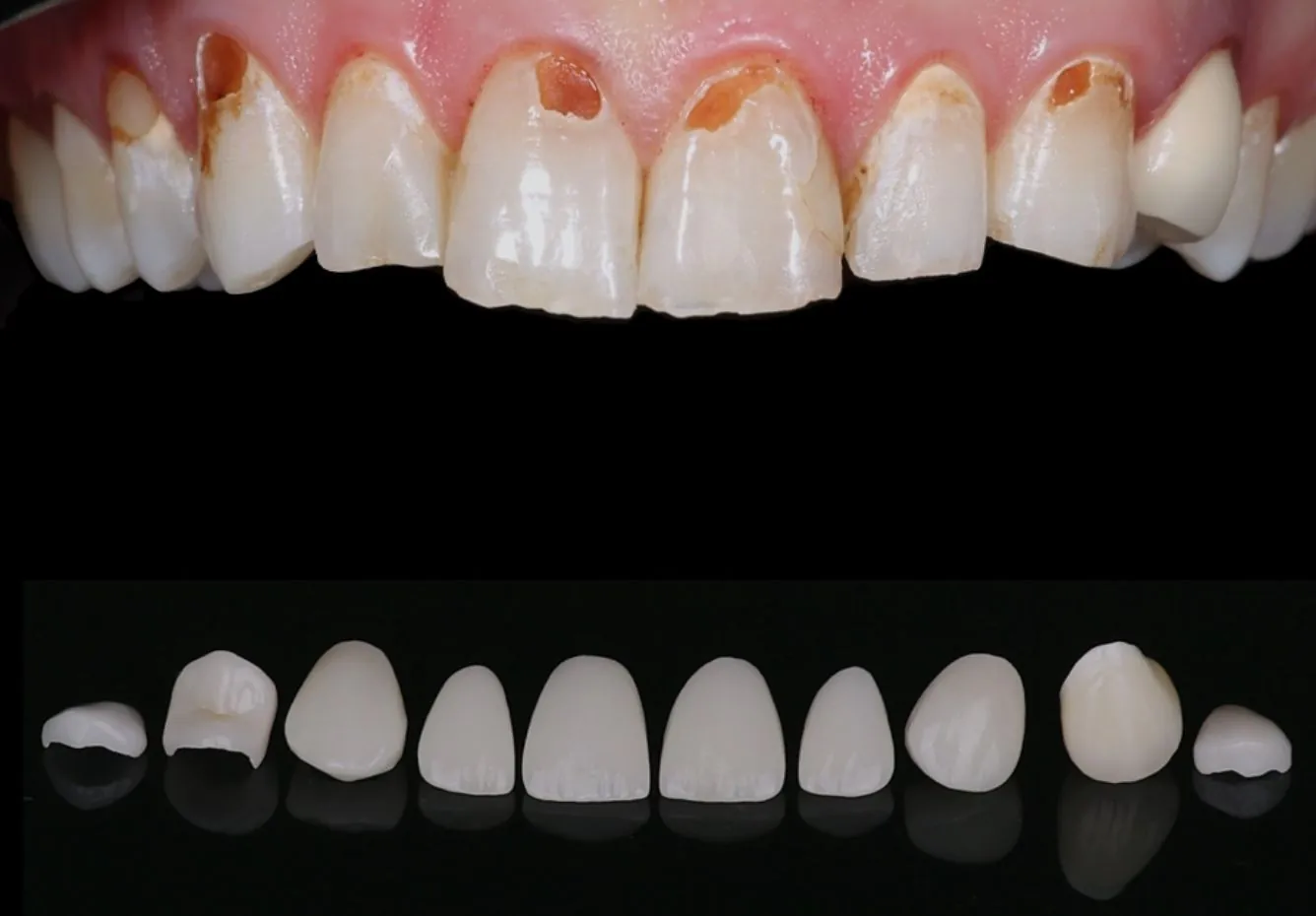
This patient presented with worn, stained, and chipped front teeth, significantly affecting smile harmony. After aesthetic planning, a set of ultra-thin ceramic veneers was applied to restore shape, brightness, and symmetry. The final result: a confident, natural-looking smile in balance with the patient's face.
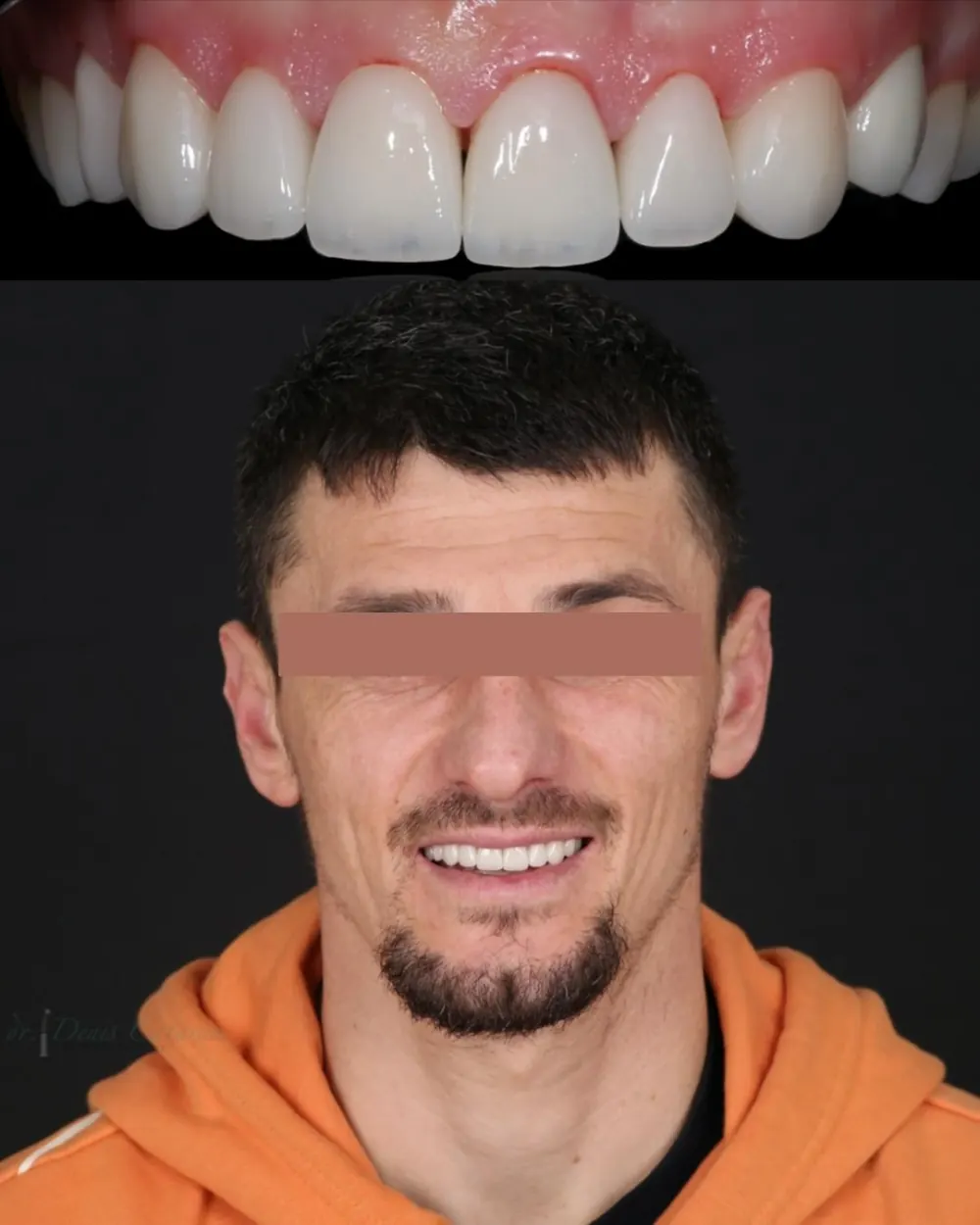
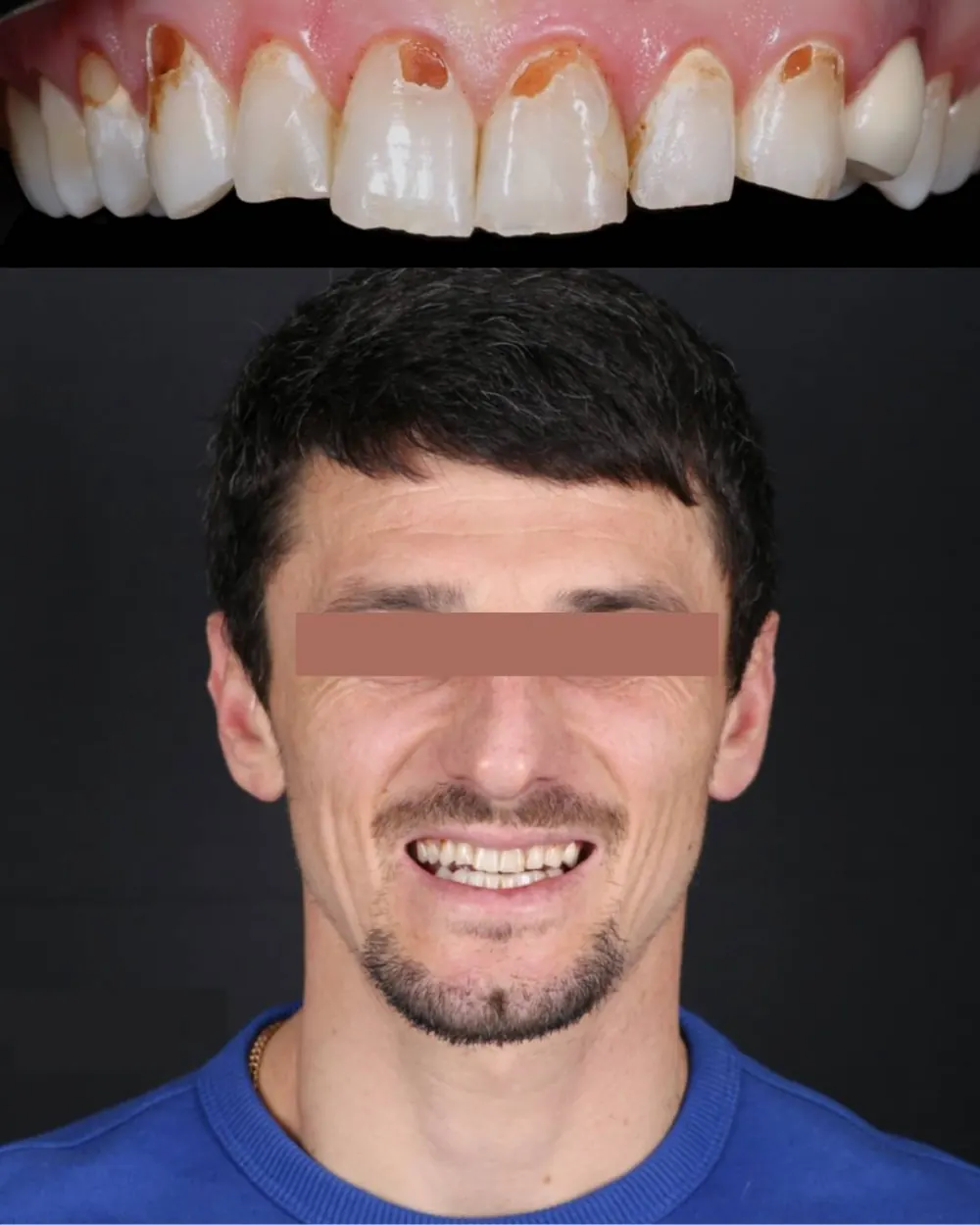 BeforeAfter
As a guide, a veneer in Belgium costs about €800-1,500 per tooth in porcelain and €250-500 per tooth in composite. The price of composite bonding, whitening or gum contouring depends on the number of teeth and the technique. Every quote is drawn up after your assessment, based on your situation.
Purely cosmetic treatment, such as veneers or whitening, is not reimbursed by INAMI, the Belgian compulsory health insurance. Some supplementary dental and international health plans pay part of the cost, with ceilings. Dr Catarau is a non-contracted (non conventionné) dentist: his fees may be higher than the INAMI agreement rates; you receive an attestation de soins for reimbursable care such as the consultation or cleaning.
Another question? The practice answers by phone, Monday to Friday.
Cosmetic dentistry covers treatments that improve how your smile looks: the colour, shape, length and apparent alignment of the teeth, and the gum line. It includes teeth whitening, composite bonding, veneers and gum contouring. It is carried out on healthy teeth and gums, after an assessment, with a preference for techniques that preserve the enamel.
Usually with an assessment and a professional clean, then the least invasive treatment that meets your goal. If your teeth are healthy but yellowed, whitening comes first, because any bonding or veneers are then matched to the new shade. For a chipped corner or a small gap, composite bonding is often enough, in a single visit.
Whitening lightens healthy teeth without changing their shape. Composite bonding corrects small flaws, such as a chipped corner or a gap, in one visit and usually without drilling. Veneers, especially porcelain ones, change the colour and shape of several teeth for the long term, but usually need a thin layer of enamel to be prepared and 2 to 3 visits.
As a guide, a veneer in Belgium costs about €800-1,500 per tooth in porcelain and €250-500 per tooth in composite. The price of composite bonding, whitening or gum contouring depends on the number of teeth and the technique. At the Etterbeek practice, every treatment comes with a written quote after the cosmetic assessment.
No, purely cosmetic treatment, such as veneers or whitening, is not reimbursed by INAMI, the Belgian compulsory health insurance. Some supplementary dental plans, offered by mutuelles or private insurers, and some international health policies cover part of the cost, usually with annual ceilings and sometimes a waiting period. Basic care, such as check-ups, cleaning or fillings, is reimbursed under the usual rules.
Not when it is properly indicated. Professional whitening does not remove enamel, although it can make teeth sensitive for a few days. Composite bonding is usually done without drilling. Porcelain veneers generally require a few tenths of a millimetre of enamel to be removed, which is irreversible, so they are kept for cases where a gentler option is not enough.
That is the main goal: a shade and shape that suit your face, lips and age, rather than a uniform white. The colour is chosen with you in daylight and, for larger treatments, a try-in mock-up lets you see the result before your teeth are touched. You approve the plan before any final work is done.
It depends on the technique: whitening usually lasts 1 to 3 years, composite bonding or a composite veneer about 5 to 7 years with maintenance, and a porcelain veneer often 10 to 15 years. Coffee, tea, red wine, smoking and teeth grinding shorten these times; regular check-ups help results last longer.
Veneers and whitening are generally for adults, from around 18, once the teeth and gums have finished developing. For teenagers, reversible options are preferred, such as a small composite repair after an accident. There is no upper age limit: what matters is the health of your teeth and gums.
Teeth turn yellow mainly because of surface stains (coffee, tea, red wine, tobacco) and with age, as the enamel thins and lets the naturally yellower dentine show through. Some medicines, an injury or a root-filled tooth can also darken a tooth. A professional clean removes surface stains; whitening, bonding or veneers treat deeper discolouration.
Dr Denis Catarau sees patients at the Cabinet dentaire Detaille, Rue des Champs 64 in Etterbeek, for a cosmetic assessment: examination, photos, options and a written quote. Whether you are thinking about whitening, veneers, composite bonding or gum contouring, the first step is the same.