All-on-4 and All-on-6 in Brussels: fixed teeth on 4 or 6 implants
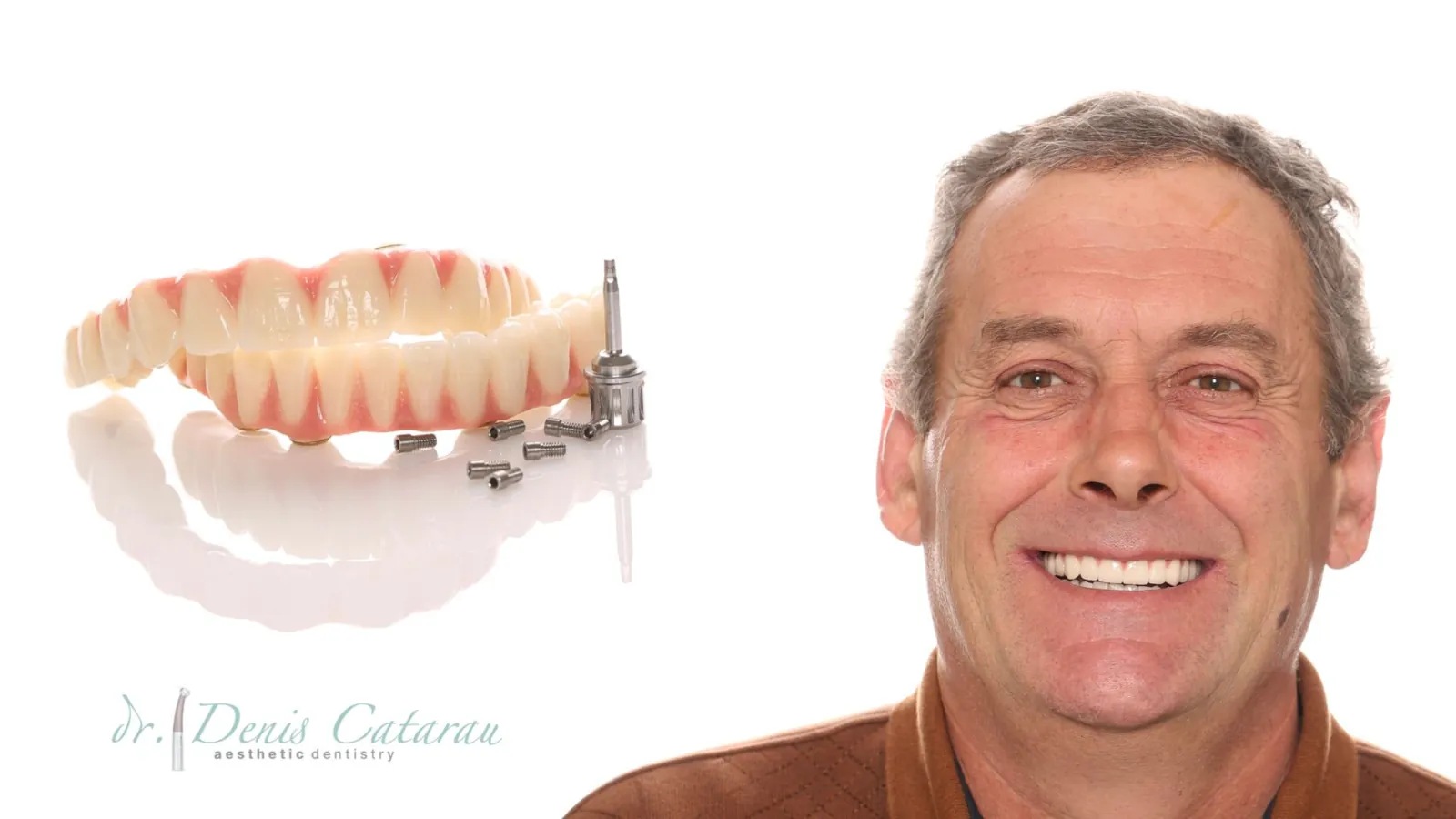
All-on-4 and All-on-6 replace all the teeth in one jaw with a fixed bridge screwed onto 4 or 6 dental implants. The treatment is for people who have lost all their teeth, whose remaining teeth can no longer be saved, or who struggle with a removable denture. Dr Denis Catarau, a dentist with experience in implant dentistry, sees patients at the Detaille dental practice in Etterbeek, Brussels.
Written and reviewed by Dr Denis Catarau, dentist in EtterbeekUpdated: October 2026
- Implants per jaw
- 4 (All-on-4) or 6 (All-on-6)
- Temporary bridge
- Sometimes within days of surgery, if the bone allows
- Final bridge
- After roughly 3-6 months of healing
- Anaesthesia
- Local
- Typical cost in Belgium
- Usually above €10,000 per jaw
What is All-on-4 or All-on-6?
It is a full-arch restoration: instead of replacing every tooth with its own implant, 4 or 6 implants are placed in the jawbone and a one-piece bridge, usually carrying 10 to 12 teeth, is screwed onto them. You do not take the bridge out at home; only the dentist can unscrew it, for example for a thorough clean.
With the All-on-4 technique, the two back implants are often placed at a slight angle. This makes the most of the bone at the front of the jaw and, in some cases, avoids the need for a bone graft or a sinus lift.
Who is it for?
A full-arch implant restoration is usually considered in the situations below. Before recommending it, Dr Catarau checks your general health, your gums and the volume of available bone.
- You have no teeth left in one jaw (complete tooth loss).
- Your remaining teeth cannot be saved: advanced gum disease, extensive decay, fractures or very loose teeth.
- You wear a removable denture that moves, rubs, makes you gag or stops you from chewing properly.
- You would like a fixed solution rather than a denture you take out every night.
All-on-4, All-on-6 or an implant-retained denture?
The right choice depends on your bone, your budget, how easily you can look after the restoration and what you expect from it.
- All-on-4: a fixed bridge on 4 implants. Fewer implants usually means shorter surgery and a lower cost, provided there is enough bone at the front of the jaw.
- All-on-6: a fixed bridge on 6 implants. Chewing forces are spread over more implants; it is often chosen when the bone allows, particularly in the upper jaw.
- Implant-retained denture (overdenture): a denture that clips onto 2 to 4 implants. It is far more stable than a conventional denture, comes out for cleaning and generally costs less than a fixed bridge.
Immediate loading: temporary teeth quickly, where possible
When the implants are firmly anchored as soon as they are placed (known as primary stability), a fixed temporary bridge can sometimes be screwed in within a few days of surgery. This means you are not left without teeth while you heal.
It is not always possible. If the bone is too soft or too thin, it is safer to let the implants heal without load and to wear a removable temporary denture in the meantime.
Care and lifespan
An implant bridge is brushed morning and evening, just like natural teeth. The underside of the bridge and the area around each implant also need cleaning with interdental brushes, special floss or a water flosser. A check-up and professional clean about every 6 months is advisable, and from time to time the bridge is unscrewed for a complete clean.
With good care and regular follow-up, implants can stay in place for many years.
Treatment steps
- 1
Consultation and 3D scan
An examination, a conversation about your expectations and medical history, then a 3D X-ray (CBCT or cone beam) to measure the bone precisely and locate the sinus and nerves.
- 2
Treatment plan and quote
Dr Catarau explains the possible options, the timeline and any preliminary treatment, then gives you a detailed written quote.
- 3
Surgery
Under local anaesthetic, any teeth that cannot be saved are removed and the implants are placed, usually in the same session.
- 4
Temporary bridge and healing
Depending on implant stability, a fixed temporary bridge or a removable temporary denture is fitted. The bone then bonds to the implants (osseointegration) over roughly 3 to 6 months.
- 5
Final bridge and follow-up
After impressions or a digital scan, the final bridge is custom-made, tried in and screwed into place. Regular check-ups then keep an eye on the implants and gums.
All-on-4 cost in Belgium and reimbursement
In Belgium, All-on-4 or All-on-6 treatment usually costs more than €10,000 per jaw. These figures are general market context, not this practice’s fees.
- All-on-4 / All-on-6 in Belgium (indicative)
- Usually above €10,000 per jaw
- What affects the price
- Number of implants, bridge material, extractions, any bone graft
- INAMI/RIZIV reimbursement
- Generally not, except in specific situations set out in the official fee schedule
- Mutuelle or dental insurance
- Partial cover possible depending on your policy (caps, waiting periods)
- At the practice
- Quote after consultation and 3D scan
Dr Catarau is a non-contracted (non conventionné) dentist, so his fees may be higher than the INAMI agreed rates. For treatments listed in the official fee schedule you receive a certificate of care (attestation de soins) and the statutory reimbursement still applies. Exact price on quote after consultation.
All-on-4 and All-on-6: frequently asked questions
Another question? The practice answers by phone, Monday to Friday.
How much does All-on-4 cost in Brussels?
In Belgium, All-on-4 usually costs more than €10,000 per jaw, including the implants, the bridge and follow-up. The amount varies mainly with the number of implants, the bridge material and any bone graft. At the Detaille practice in Etterbeek, the price is set on a written quote after the consultation and 3D scan.
What is the difference between All-on-4 and All-on-6?
The difference is the number of implants supporting the bridge: 4 or 6. With 6 implants, chewing forces are spread more evenly, which is often preferred when the bone allows. With 4 implants, surgery is shorter and a bone graft can sometimes be avoided. The choice is made after a 3D scan of your jaw.
Can I have fixed teeth straight after surgery?
Sometimes, yes. If the implants are stable enough when placed, a fixed temporary bridge can be screwed in within a few days. If the bone is too soft or thin, it is safer to wait for healing with a removable temporary denture. This depends on your bone quality and is confirmed during the procedure.
Does All-on-4 surgery hurt?
The procedure is done under local anaesthetic, so you should not feel pain during surgery. Swelling and discomfort are common for the next few days; they usually ease within 3 to 7 days and are managed with prescribed medication, cold compresses and soft food.
How long does the whole treatment take?
Usually 4 to 8 months from the first assessment to the final bridge. Surgery takes place in a single session, then the bone needs roughly 3 to 6 months to bond with the implants. If a bone graft or preliminary treatment is needed, the timeline can be a few months longer.
Do I need a bone graft for All-on-4?
Not necessarily. All-on-4 was designed to make the most of existing bone by angling the back implants. A bone graft or sinus lift is still sometimes needed when the bone has shrunk a lot, especially in the upper jaw. Only a 3D scan (CBCT) can show what is right in your case.
How long does All-on-4 last?
With good care and regular check-ups, the implants can last for many years. The bridge wears faster: acrylic teeth may need replacing after several years, while ceramic and zirconia hold up better. Smoking, poorly controlled diabetes and teeth grinding (bruxism) increase the risk of complications.
Is All-on-4 reimbursed by INAMI or my mutuelle?
Generally, Belgian compulsory health insurance (INAMI/RIZIV) does not reimburse implants, except in a few specific situations set out in the official fee schedule. Some mutuelles and private dental insurers cover part of the cost, with caps and often a waiting period. Check with your insurer using the quote; you receive a certificate of care for reimbursable treatments.
Related treatments
Treatments that are often considered together.
Let’s talk about your situation
At a first consultation at the Detaille dental practice in Etterbeek, Dr Catarau examines your mouth, listens to what you want and explains the possible options. Book online through Doctoranytime.